Course Guide
Academic Advancement Course
This is a course aimed at advancing to higher education institutions in Japan. Students are divided into classes from beginner level according to their Japanese proficiency, and comprehensively acquire Japanese as a means of communication while improving their abilities in five language activities: ‘reading, listening, writing, speaking (interaction), and speaking (presentation).’ We also prepare for the Examination for Japanese University Admission for International Students (EJU) to polish Japanese language skills toward advancement. In addition, the homeroom teacher and all school faculty and staff work together to carefully provide personalized support such as academic counseling and interview practice.
| Course | ||||||
|---|---|---|---|---|---|---|
| Course | Entry Period | Application Period | Application Deadline | Certificate Results | Entry Procedures | Arrival & Enrollment |
| Science/Eng. 2-Year Course | April | From July | October 15 | Around February 20 | March | Early April |
| Science/Eng. 1.5-Year Course | October | From January | May 15 | Around August 20 | September | Early October |
Tuition Fees
| Tuition Fees (Unit: JPY, tax excluded) | ||||||
|---|---|---|---|---|---|---|
| 1st Year (all courses) | 2nd Year - 2yr Course | 2nd Year - 1.5yr Course | ||||
| Examination Fee | ¥20,000 | |||||
| Enrollment Fee | ¥50,000 | |||||
| Tuition | ¥600,000 | ¥600,000 | ¥300,000 | |||
| Facility Fee | ¥50,000 | ¥50,000 | ¥25,000 | |||
| Equipment Fee | ¥50,000 | ¥50,000 | ¥25,000 | |||
| Teaching Materials Fee | ¥30,000 | ¥30,000 | ¥15,000 | |||
| Extracurricular Fee | ¥15,000 | ¥15,000 | ¥7,500 | |||
| Insurance | ¥10,000 | ¥10,000 | ¥5,000 | |||
| Health Management Fee | ¥5,000 | ¥5,000 | ¥5,000 | |||
| TOTAL | ¥830,000 | ¥760,000 | ¥382,500 | |||
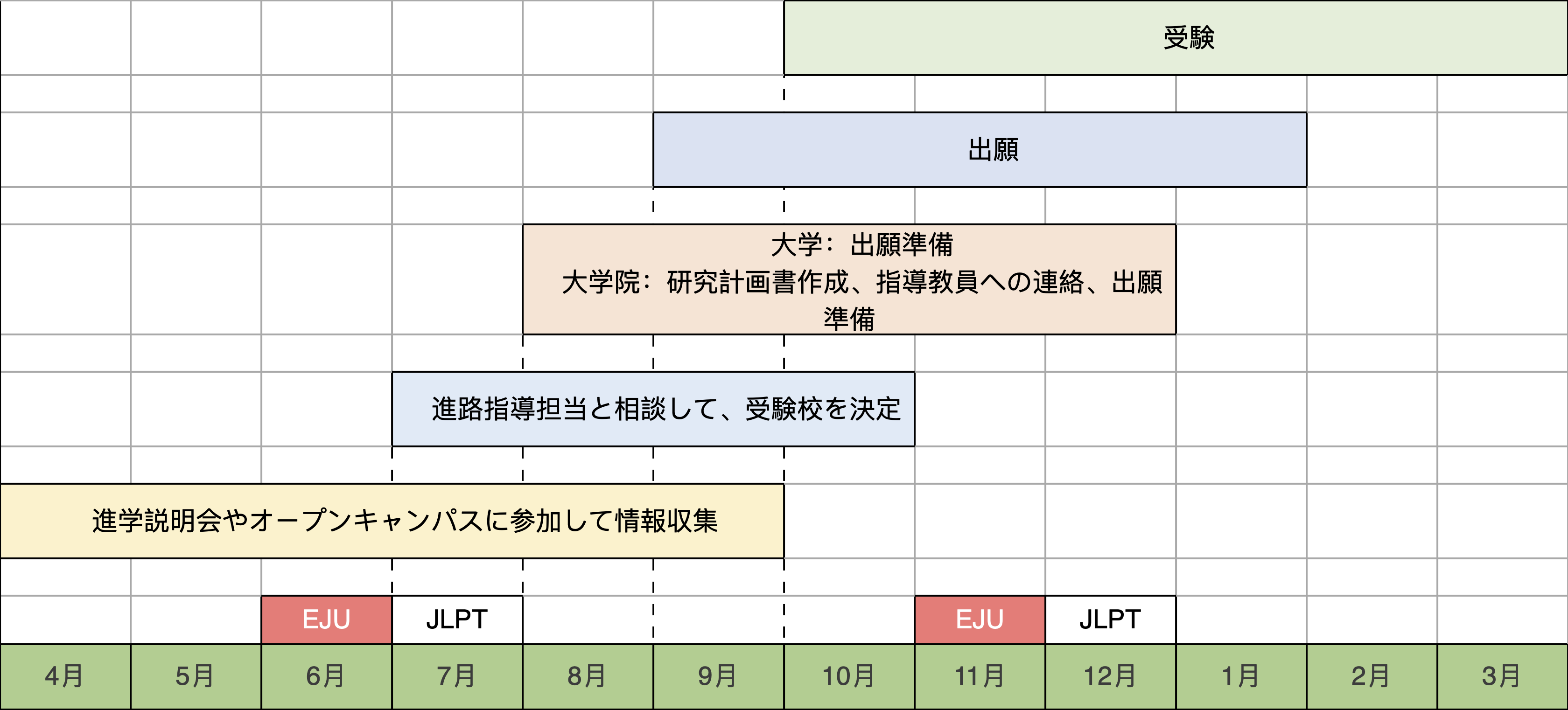
Annual Schedule for Advancement (2nd Year)
※ Note: The schedule may vary significantly depending on the school you are applying to.
Teaching Materials
| Term | Year 1 - First Half | Year 1 - Second Half | Year 2 - First Half | Year 2 - Second Half |
|---|---|---|---|---|
| Level | Beginner 1~2 | Lowe-Intermediate~Intermediate | Upper-Intermediate | Advanced |
| Reference Level | A1・A2 | B1 | B2 | B2 |
|
Writing Reading Listening Interaction Delivery Skills |
|
|
|
|
|
|
Listening Materials (Original) |
|
|
|
Example Sentence Workbook (Original) |
|||
|
Listening Materials (Original) |
|||
|
||||
Kanji Book (Original) |
| Term | Year 1 - First Half | Year 1 - Second Half | Year 2 - First Half | Year 2 - Second Half |
|---|---|---|---|---|
| Level | Beginner 1~2 | Lowe-Intermediate~Intermediate | Upper-Intermediate | Advanced |
| Reference Level | A1・A2 | B1 | B2 | B2 |
| PBL |
|
No Textbook | No Textbook | |
| Career | Academic Advancement Guidance Notebook (Original) |
|||
| EJU Prep |
|
|
||
|
|
|||
|
|
|||
|
||||
Class Schedule
| Time | Mon | Tue | Wed | Thu | Fri |
|---|---|---|---|---|---|
| 9:00〜9:45 | Interaction | Interaction | Interaction | Interaction | Interaction |
| 9:55〜10:40 | Interaction | Interaction | Interaction | Interaction | Interaction |
| 10:50〜11:35 | Writing | Writing | Writing | Writing | Writing |
| 11:45〜12:30 | Career | Listening | Reading | Delivery Skills | Delivery Skills |
| Time | Mon | Tue | Wed | Thu | Fri |
|---|---|---|---|---|---|
| 13:30〜14:15 | Writing | Writing | PBL | PBL | EJU Prep |
| 14:25〜15:10 | Writing | Reading | PBL | PBL | EJU Prep |
| 15:20〜16:05 | Reading | Delivery Skills | Interaction | EJU Prep | EJU Prep |
| 16:15〜17:00 | Listening | Delivery Skills | Interaction | EJU Prep | Career |
※ The schedule shown is an example.
Subject Descriptions
| Subject | Language Activity | Content |
|---|---|---|
| Writing | Writing | Develops progressively from basic short sentence creation, through sentence construction using conjunctions, to logical text development. Ultimately, students acquire the ability to create academic specialized texts and write persuasive essays using argumentative structure, evidence, and examples. |
| Reading | Reading | Starts with reading simple explanatory texts and develops reading comprehension skills that grasp the overall structure of texts and follow logical development. Ultimately, students acquire academic reading ability that enables logical analysis of scientific papers and evaluation of validity through critical thinking. |
| Listening | Listening | Starts from understanding basic conversations and explanations, and develops toward understanding everyday conversations and specialized lecture content. Ultimately, students acquire academic listening skills that allow them to understand content at the level of actual university lectures and take notes. |
| Interaction | Speaking (Interaction) |
Starts from exchanging opinions on simple scientific topics, and develops through discussions on familiar themes to professional discussions. Ultimately, students acquire advanced conversational ability to constructively develop arguments on complex themes such as artificial intelligence and nuclear power generation. |
| Delivery Skills | Speaking (Presentation) |
Starts from basic presentations on familiar themes, and develops through use of visual materials to structured presentation formats. Ultimately, through research process presentations and graduation presentations in specialized fields, students acquire academic presentation skills. |
| PBL (Project-Based Larning) |
Writing Reading Listening Speaking |
Starts from practical activities such as Japanese culture, disaster prevention, and recycling, and develops problem-solving ability through cooperation with local communities. Ultimately, students acquire practical problem-solving skills on science/engineering specialized themes such as urban transportation system design and energy-saving verification. |
| Career | Writing Reading Listening Speaking |
Starts from basic career design using academic guidance notebooks, narrows down specialized fields, participates in open campus events, and advances academic preparation. Ultimately, through statement of purpose writing, interview preparation, and mock interviews, students acquire practical examination preparation skills. |
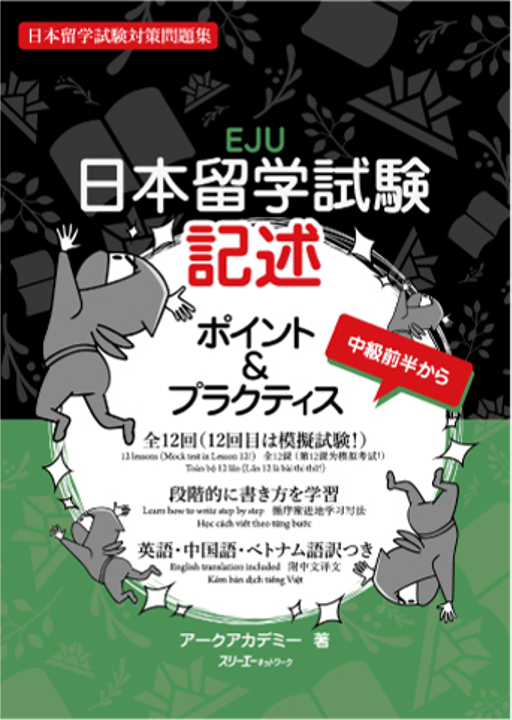
| EJU Preparation | Writing Reading Listening |
Starts with familiarization with EJU question formats, learning basic composition and connecting expressions, and logical text creation. Ultimately, through mock exam practice, aims for a target of 300 points (reading/listening) and written section 40 points, acquiring ability to handle the actual EJU exam. |